Describe what you want to accomplish. Codex turns your rough idea into an editable professional proposal. Choose Implement, and AgentFoundry creates the agents, steps and connections for you.
No hand-wiring required. A native macOS studio, powered by your locally installed Codex runtime.
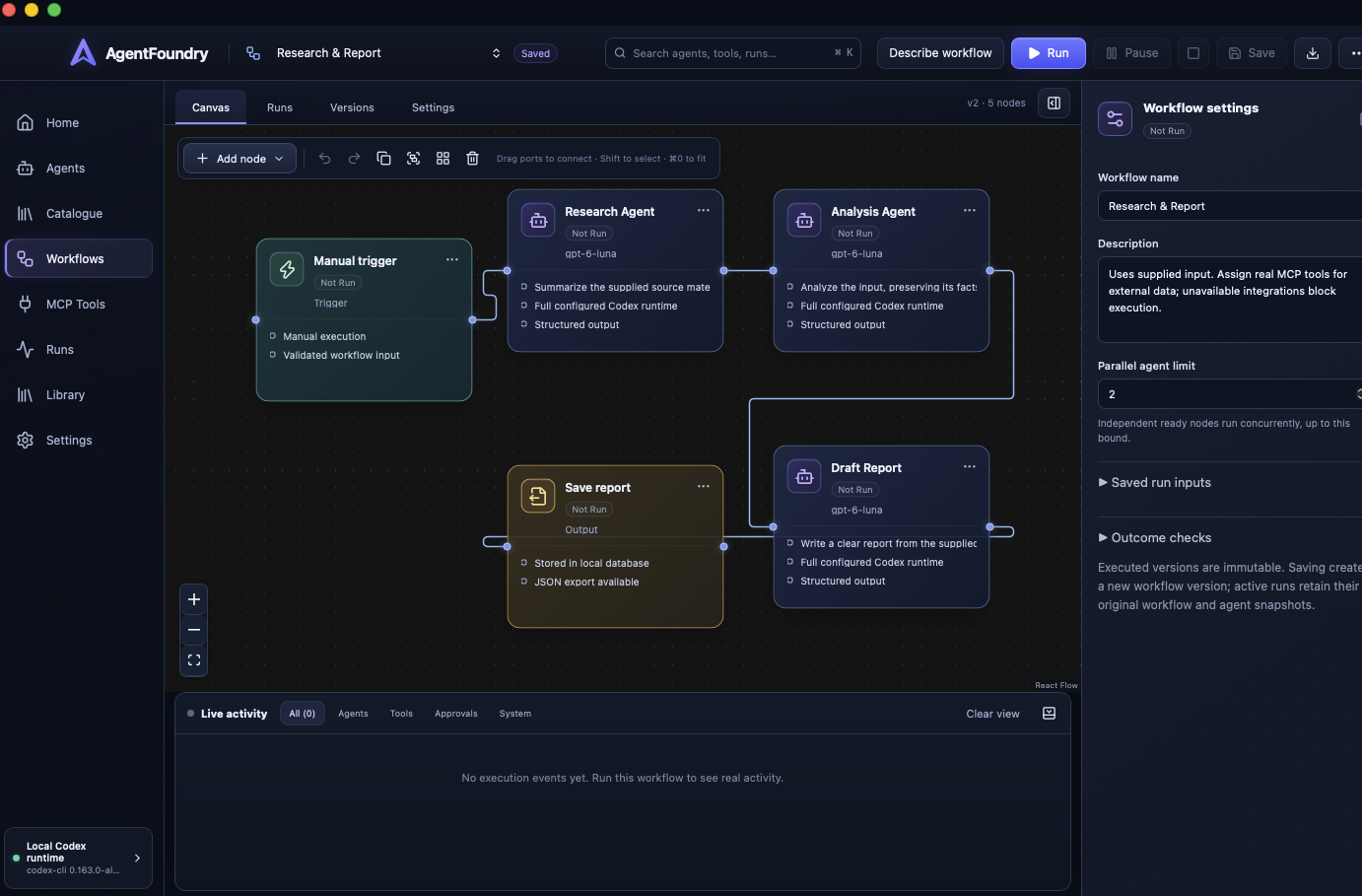
The canvas makes the flow visible. You can start with a sentence instead of an empty graph.
THE REASON BEHIND IT
It started with curiosity.
I created AgentFoundry because I wanted to understand agent workflows by seeing them: what each agent does, how work moves between steps, and what actually happens when a flow runs.
Then another question became more interesting: why should setting up the workflow be the hardest part? I wanted to explain an outcome in everyday language and have the app turn it into a clear, reviewable setup. That experiment became this studio.
Built out of curiosity. Shared as an evolving MVP.
THE MAIN IDEA
Describe the outcome. Let Codex build the flow.
You do not have to create every agent manually, write each set of instructions, or connect the nodes yourself. AgentFoundry uses Codex to translate your intent into a workflow you can understand before you run it.
01 Rough idea→02 Editable proposal→03 Implement→04 Review & run
01 / DESCRIBE
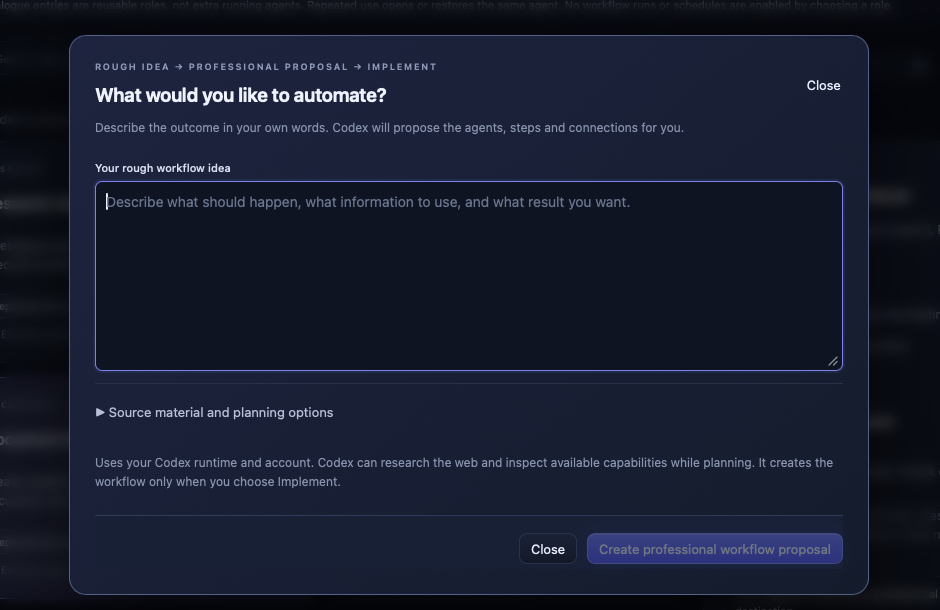
Start with what you need.
Explain the task, the information to use and the result you want. Add source documents if useful. Codex works out a proposed structure using the available runtime capabilities.
“Read today’s news, analyse the five leading stories, and save a PDF briefing on my desktop.”
A prompt is the starting point, not a manually assembled canvas.
02 / REVIEW & REFINE
A professional proposal. Still your words to change.
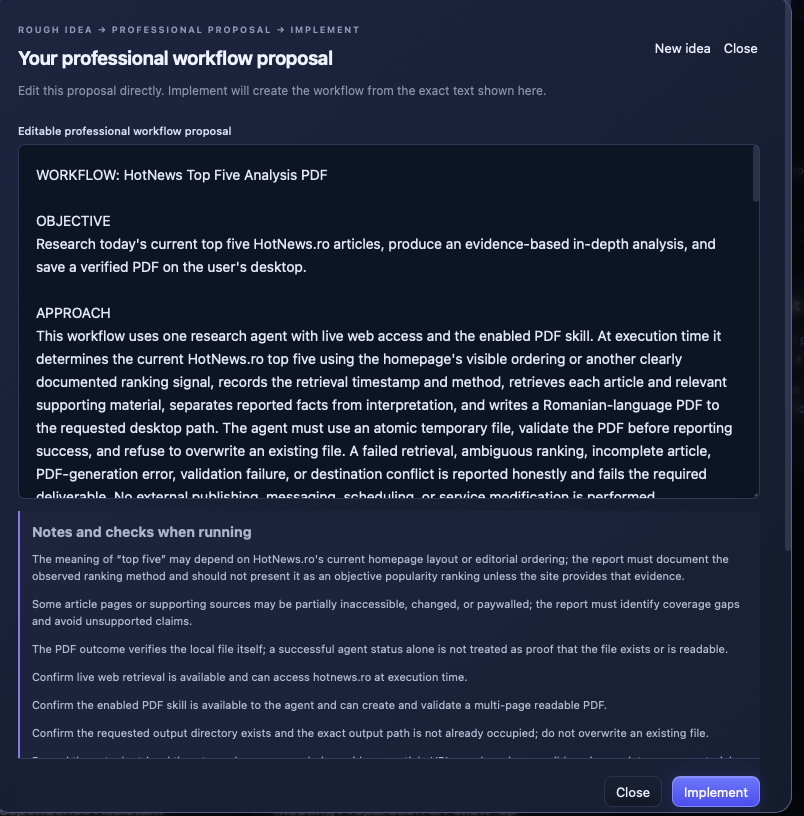
Review the objective, agent responsibilities, planned outputs and checks. Edit the proposal directly, or ask Codex to refine it. You remain in control of the task and its scope.
Runtime access conditions are visible. A possible paywall or an account check is treated as something to verify when running, rather than an automatic reason to reject a valid setup.
The proposed approach is editable before it becomes a workflow.
03 / IMPLEMENT
One decision. The setup is created.
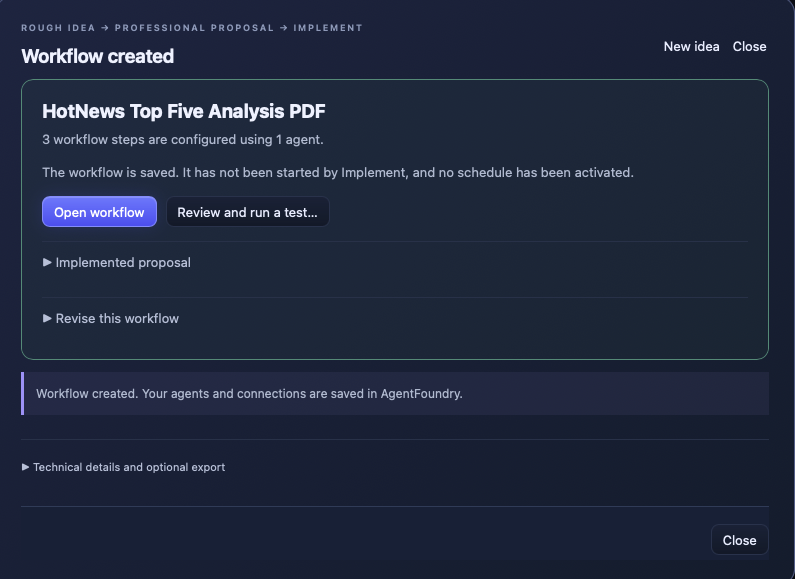
Choose Implement. AgentFoundry validates the approved proposal and automatically saves the agents and connected workflow. You can then open the visual flow to inspect or refine it.
Implementation creates the configuration. It does not silently execute the task or activate a schedule.
From approved text to configured agents and connections.
04 / EXECUTE
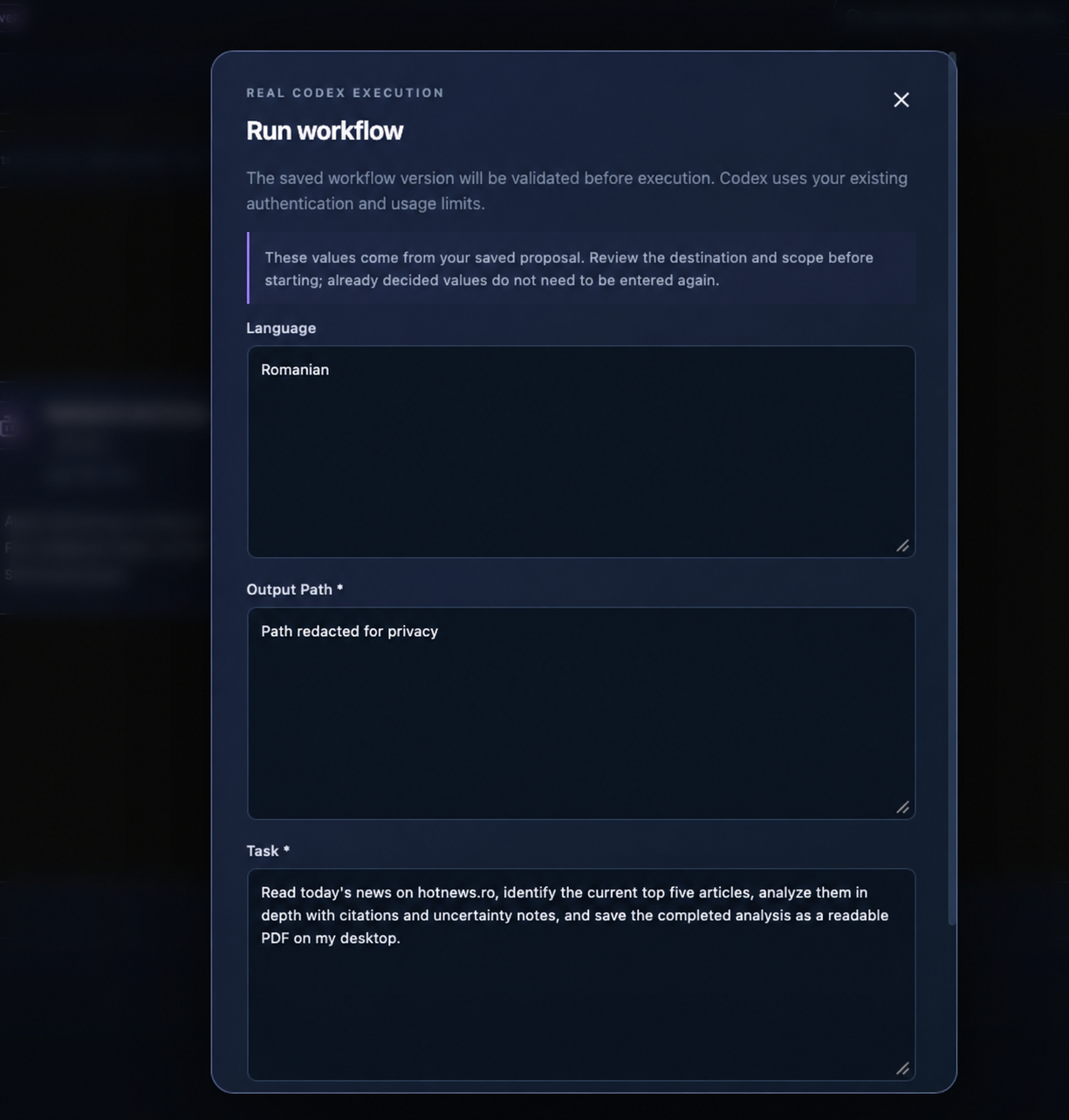
Review the inputs. Run with real evidence.
Check the saved inputs and destination, then start execution. Follow the real activity, tool calls and results in Runs. Where configured, independent output checks help distinguish a completed turn from a result that actually exists.
For a PDF, that can mean opening and checking the file itself. For a service action, the evidence reflects what the actual provider response confirms.
Saved inputs stay reviewable. This screenshot has a local path redacted for privacy.
A STUDIO AROUND THE FLOW
Make the work understandable.
↗
See the structure
A visual canvas shows the steps, connections and data flow, with optional manual refinement when you want more control.
◇
Reuse specialist roles
A catalogue of 20 specialist roles provides starting points for research, documents, data, engineering and everyday coordination.
⌘
Use your runtime
Discover available Codex models, skills, connected tools and MCP integrations instead of recreating a separate AI setup.
✓
Inspect actual results
Execution history, artifacts and declared outcome checks make it easier to see what succeeded and what still needs attention.
◷
Repeat useful workflows
Schedule recurring work while the app is open and your Mac is awake. Optional verified checkpoints support repeated monitoring.
↶
Keep room to refine
Versioned definitions and recoverable library deletion help you experiment without throwing away earlier work.
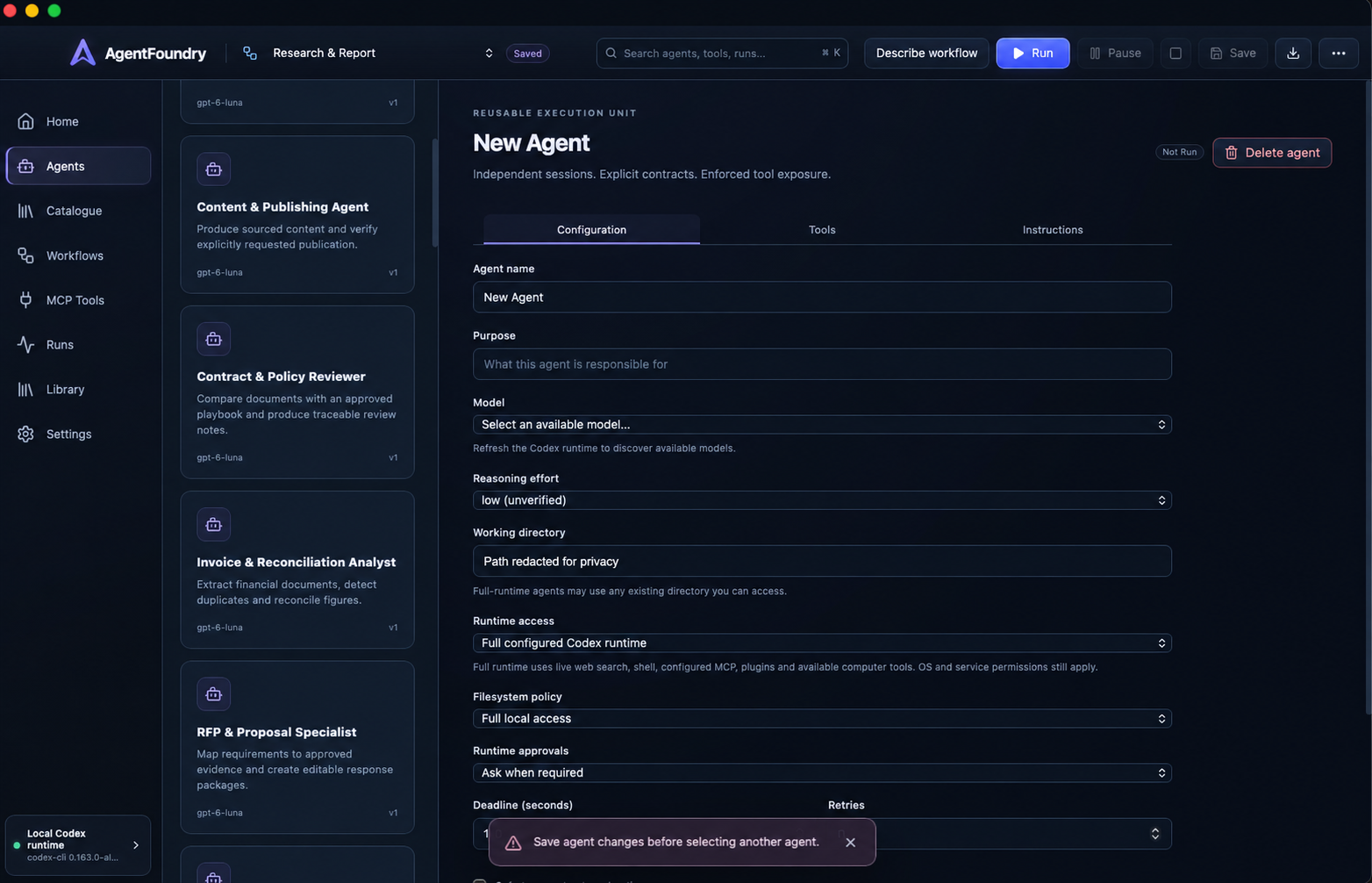
Agent-level controls are available when you need them. The guided workflow builder handles the setup for you. Local path redacted for privacy.
TWO WAYS TO PUT IT TO WORK
Useful outcomes. Ordinary-language requests.
RESEARCH → ANALYSIS → PDF
A daily news briefing
“Read the five leading stories on HotNews.ro, analyse what matters, include the sources, and create a PDF on my desktop.”
Codex proposes the research and document steps, AgentFoundry creates the flow, and execution produces a reviewable briefing with the configured file checks. Enable a schedule separately if you want to repeat it.
DOCUMENTS → SYNTHESIS → BRIEF
A clearer project update
“Review these project notes, identify decisions, open questions and risks, and turn them into a concise progress report.”
Start with supplied documents. Review the proposed analysis and report structure, implement it, and reuse the workflow as new notes arrive. You can inspect the connected steps without building them by hand.
These examples illustrate the intended workflow pattern. Actual access, output scope and verification depend on the sources, tools and checks configured for that task.
YOUR MAC. YOUR CODEX.
Bring your own Codex account.
AgentFoundry is designed to use the Codex runtime installed on your own Mac and your own authentication. It does not ship with the creator’s credentials or require you to share an account.
With an AgentFoundry build installed: open Settings → Codex → Set up local Codex. Let the app discover the executable, or select it yourself. It checks the runtime and account, offers the supported browser sign-in flow when needed, and lets you select an available model.
Run the connection test. AgentFoundry waits for a real completed response, then enables Use this setup. Existing local authentication is reused where available. Custom-provider or managed-account configuration stays with Codex’s own supported setup.
Your configured provider’s usage limits and charges apply. The Codex process and orchestration run locally; model inference uses your configured service and is not necessarily offline. Workflow material may be sent to that service and the tools you choose.
Showcase edition. This repository shares the product story and screenshots. No installer, DMG, application binary or application source code is distributed here.
VERSION 1 / AN EVOLVING MVP
A focused first chapter.
Version 1 explores an approachable way to create, visualise and run agent workflows. The emphasis is on a strong idea-to-setup experience, clear review points and observable execution.
A desktop companion
Scheduling works while AgentFoundry is open and the Mac is awake. Background execution with the app closed and authenticated external event triggers are future directions.
Real connections, real scope
Service authentication, browser sessions and OS permissions remain task-specific. Subscribed content needs an accessible authenticated route; discovery alone does not prove account access.
Evidence with a clear meaning
Checks establish the properties they actually verify. A file check does not certify the quality of an analysis, and provider acceptance does not establish that a message was delivered or read.
Room to grow
Broader provider acceptance testing, large-workflow accessibility and performance, background operation, and portable public distribution are natural next steps. Document OCR is bounded and benefits from review.
Less setup. More understanding.
A small experiment in making agent workflows easier to create—and easier to see.